
ARCI Field Officer
Emergency Response Team
Responsible for coordinating field activities, assessing community needs, and ensuring timely delivery of shelter support to affected families.


The hostilities in Al-Fasher between the joint forces of the Juba agreement and SAF from one side and RSF from the other, along with artillery shells in ZamZam IDP camp since October 2024 and still ongoing, have led to wide displacement of population from Al-Fasher to different areas within North and Central Darfur States.2
An estimated 406,265 individuals (81,252 households) were displaced from Zamzam IDP camp between 13 and 14 April 2025. DTM field teams estimated that approximately 81 per cent of the households previously recorded at Zamzam IDP camp were displaced again following the heightened insecurity in April 2025. As of 27 April 2025, IDPs displaced from Zamzam IDP camp were recorded across 19 localities in four states across the Darfur region. IDPs displaced from Zamzam were primarily displaced to locations within North Darfur state (97%), as well as to locations across Central Darfur (2%), South Darfur (<1%), and East Darfur (<1%) states. The same report suggests that Tawila currently hosts 60,660 households from among the 81,252 households displaced.
The project aims to reach a total of 1310 HHs crisis-affected individuals with shelter and settlements support, 2 IDPs gathering sites across Tawila Locality in North Darfur, supporting IDPs who were displaced in April from Zamzam camp. The response has been coordinated with DCES – partner under the RRF which planson distributing 450 ES kits in Tawila,and the ESNFI Darfur Cluster Coordination mechanism.
To ensure accountability to affected populations (AAP), and to mitigate any risks of harm and abuse that the above groups may face as a result of the displacement and/or project activities, ARC will use existing complaints and feedback mechanisms (CFMs) to ensure that interventions are conflict- and gender-sensitive, inclusive, and follow protection and other humanitarian principles. Through the project’s activities, 1,310 ES will be distributed to the newly displaced and conflict-affected HHs in Tawila Locality North Darfur State.
A description of the projectoutput and activities are outlined below.
Output 1: Sub-Sector – Emergency Shelter(ES)
Activity 1.1: Conduct introductory meetings; to share clear communication about the scope of the project, selection criteria3 and ensure that all stakeholders understand the process. ARC will conduct 2 meetings. The two meetings will be conducted in Tawilla Locality - one meetingwith local government in Triba VillageIDPs gathering sites,one meeting with local government
the localities level with the community leaders. The meetings will involve locality and village representatives, ARC and committees composed of the affected communities (including IDPs). Wherever such committees do not exist, ARC will establish such committees and provide basic training to the committee members. ARC will facilitate the identification of the target beneficiaries based on the set beneficiary selectioncriteria. The introductory meetings will take place before listing any potential beneficiaries, transporting items, or identifying the specific sites. Key points to be addressed in the introductory meeting include:
We Are All In platform.
Activity 1.2: Identify and register beneficiaries. Following the agreement of target sites, the established project committee will identify and registerbeneficiaries. Local committees that have previously been established in target locations will be engagedwith them when applicable. The committee will conduct a basic identification assessment to inform the subsequent selection and registration of beneficiaries. The relevant parties from the locality, target site, and committee will work as a team with ARC, to carry out the registration. This will reduce challenges during verification; however,independent verification will be conductedby ARC (see Activity 1.3). CFMs will be incorporated into the selection process.
Activity 1.3: Complete final verification. The final verification will be done independently by ARC and carried out at household level in-line with the vulnerability and selection criteriaelaborated in the previous section.Groups with specificneeds that will be prioritized for assistance include girls and boys at risk, including USC, persons with serious health conditions, persons with special legal or physical protection needs, single women, female-headed households, older persons, PWD, etc. The verification process will also provide ARC an opportunity to identify vulnerable households among the beneficiaries that require special attentionto access and use projectinputs, so that the team can appropriately plan for additional support accessing the distribution sites, safely transporting in-kind materials, and distribution to specific households by ARC staff as needed. Together with the committee of community leadersestablished/identified under Activity1.1, ARC will develop a distribution plan and sharethis with IOM.
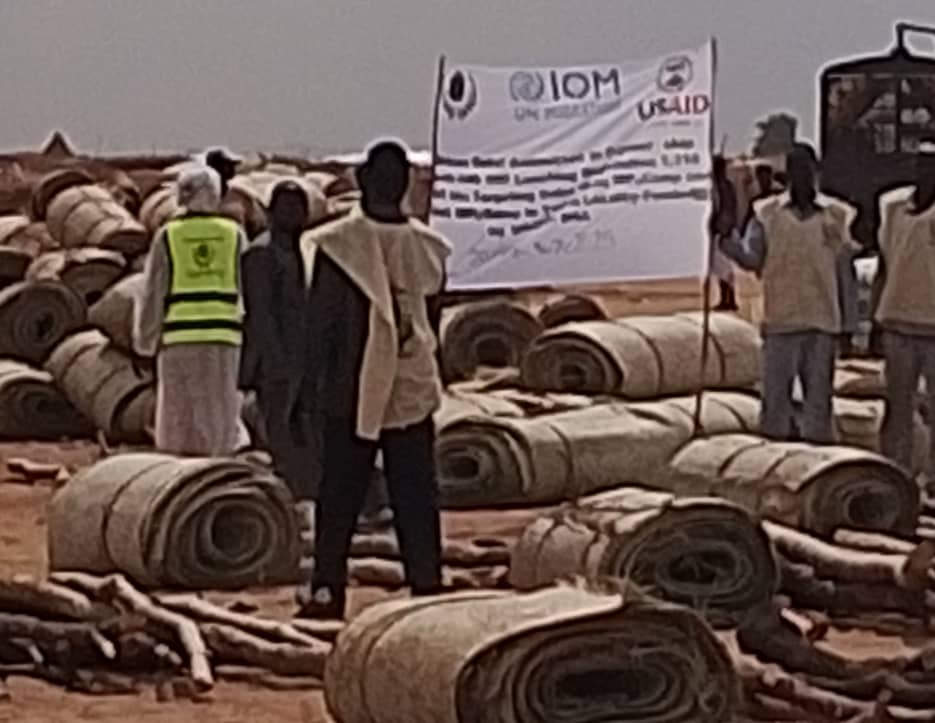
Activity 1.4: Receive the in - kind of the ES items ARC will receive 1,310 ES items from the RRF pipeline as in-kind items from the warehouse in Nyala. ARC will consider mitigation measures during the delivery process to reduce adverse environmental impacts such as the disposal of the plastic sheets after their use. IOM assures that the material purchased meet ES cluster standards. ARC will make sure to prepareall the supporting documents needed from the authorities to facilitate the transportation of the items from South Darfur-Nyala to East Darfur-Eldeain on time, this activity will closely coordinate with verification activity to immediately transport the items when verification is done and start the distribution avoidingany kind storing/warehousing risk.
Activity 1.5: Provide training in shelter construction. through constructing 40 demonstration shelters (20 per each target location). ARC will conduct trainingfor beneficiaries on how to construct their shelter in line with cluster standard,The 20 shelter per locality built as demonstration shelters will be given to the most vulnerable households (persons with special needs, such as elderly, female-headed households and persons with disability). This training should reference USAID/BHA tarp installation best practices, to maximize the efficacy and longevity of ES materials available in this video.
Activity 1.6: Provide training on fire and termite prevention. Another training course will be provided during the distribution of ES on fire and termiteprevention to ensurethe safety and durability of the ES materials. This training will be coordinated with the local fire department in East DarfurState, and a specialist firefighter will facilitate this training. The fire-prevention trainingsession will be attended by most of the target communities and will be held in open area during the distribution of the items. To assure the quality ARC will contract an expertise person from “civil-defense, department of firefighting” at locality level to facilitate this session, the civil defense expertise person will provide the session using available materials to IDPs community such (water and soil) and no chemicals will be used
Activity 1.7: Distribute of 1,500 ES kits to IDP households and affected population by displacement from Zamzam Camp. During the distribution of ES kits, ARC will developa distribution plan and share this with IOM in advance. The ES kits are in line with the sector’s standards. The plan will include selection of the distribution side that suits all stakeholders (accessible location for beneficiaries and transporters), also ARC will consider the most vulnerable groups during the distribution by designating volunteers to support them on collecting their items and build their shelters. A CFM box will be established in a notable place to assure protection and AAP are thoroughly mainstreamed and receive the beneficiary complaints and try to deal with the most urgent one.
| Type of kit | Description (tech specs) | Qty/kit |
| Emergency Shelter Kits | Bamboo sticks (50mmdiameter) - 30 pieces | 30 |
| Bamboo sticks (30mmdiameter) - 30 pieces | 30 | |
| Grass mats - 1 m2 | 30 | |
| Wooden poles (Y poles) - 3m length, 80-100 mm diameter | 8 | |
| Wooden poles - 5m length,60-80mm diameter | 4 | |
| Rope (1kg) | 2 | |
| Plastic Sheet (4mx 6m) | 2 |
Activity 1.8: Conduct post-distribution monitoring (PDM). Due to the short timeframe of the project, the PDM mission will be conducted one week after the distribution. Enumerators will be trained to collect data and conduct assessments using tools adapted to this project, and they will survey a representative sample of households using standardized data collection tools in the area that received assistance. A PDM report along with a clean dataset will be prepared and shared with IOM. For the PDM, ARC will select 80 beneficiaries using a stratified sampling method to measure primarily the effectiveness and impact of the intervention. The stratification will be done primarily along the lines of ages and gender to measure the response of this project for these different population groups and their different needs. Special attention will be given to also include PwDs and female- headed households.
Accountability to Affected Populations: ARC will disseminate the IOM’s CFMs, which includes the email address (SudanCFM@iom.int) for queries, complaints, and feedback, as well as two phone lines (Sudani: 0110266042; Zain: 900900356) to receive calls and WhatsApp messages. Community involvement and consultations are a priority and will be ensured at every stage of the projectcycle. The projectwill substantively adopt a beneficiary accountability approach, includingan alignment with IOM’s AAP and prevention of sexual exploitation of sexual exploitation and abuse (PSEA) guidelines and requirements. This alignment includes PSEA training that will be mandatory for all staff involved in the project.
While a Complaints and FeedbackBox will be established at the site, and the complaints will be dealt with in a confidential manner while feedback will be used to adjust the programming, ARC will also hold discussions with the affected populations and the committee of community leaders identified under Activity 1.1 to identify other CFMs that the local population may prefer.
Conflict Sensitivity: Throughout the implementation of activities, ARC will work closely and collaboratively with cluster partners and involving OCHA Darfur focal per son to ensure facilitation of transportation process and integrated approach for meeting the target populations’ needs. The project will also seek effective coordination with local authorities and humanitarian partners on the ground. ARC will ensure that core humanitarian standards, ‘do no harm’ principles are adhered to, while protection will be mainstreamed in interventions to promote meaningful access, safety and dignity. Protection Mainstreaming: Priority will be placed on maintaining meaningful access to assistance and services, based on identified needs and without any barriers or discrimination. The project will provide special attention to individuals and groups who may be particularly vulnerable to accessing assistance and services. The protection will be mainstreamed within the proposed activities of the project as ARC will assure that the most vulnerable households (persons with special needs, such as elderly, female-headed households with 3-4 childrenunder 5 years old, or person with disability, will not be left behind and they will have the same opportunities as others.
ARC will provide brief biweekly updatesto IOM on the progressof activities, fulfillment of project objectives, and financial position as well as submit interim (mid-term) and final narrative and financial reports halfway through and at the end of the project to IOM, in line with donorrequirements and stipulations. Project activities will be monitored by regular supervision visits to field sites and data collection by ARC, while the distribution planning will be communicated to IOM so that IOM’s field monitoring enumerators may be presenton the day of distribution. The adherence to AAP and PSEA guidelines will be regularlymonitored by IOM protection personnel, as well as surveyed, throughout and at the end of the project. Interviews will be conducted after the distribution as part of the PDM to ensurethe relief items reached the IDPs, Host Communities Returneesand Household affected by flood most in need and that items met the respective beneficiaries’ expectations. In addition, ARC will actively seek informal community feedback on project progress and impact, including providing opportunities to share any complaints, through a beneficiary CFMs to ensureAAP and PSEA. In partnership with IOM, ARC will also explore ways of involving communities and local authorities in more formal observation and monitoring mechanisms as well as in the final evaluation of the project – wherein primarily, their concerns will be noted in the PDM report, but also in the final report wherein the observations made by the community leadersduring the projectimplementation – from the registration, verification to the designs and distribution schedule of the ES kits will be considered.
During the course of project implementation, ARC will attach USAID and IOM logos on all relief items delivered to the affected population. Moreover, logos will also be added to the bannersdisplayed during all project activities. ARC will carry out interviews with the targeted communities to determine the extent to which the project has addressed the needs of affected populations. If consent is granted by interviewees, ARC will use the information gathered to create “success stories.” ARC will share regular updates, which mention USAID/BHA and IOM/RRF, through Channels, social media/blog posts, sitreps, newsletters, and press releases to highlight the project. All communication and visibility materials will be produced after consultation and approval of IOM.


